- Editeur(s) : Don't Panic Games
- Designer(s) : Vangelis Bagiartakis, Varnavas Timotheou
- Artist(s) : Dimitris Anastasiadis, Jakub Skop, Katerina Xerovasila
- Players : 2–4
- Playing time : 90–180 Min
- Weight BGG : 4.26
What's this?
What if your next board game required you to manage an entire economy while trying to promote your own political ideas? That’s precisely the premise of Hegemony: Lead Your Class to Victory, a highly asymmetrical board and card game in which each player embodies a social class with its own objectives, mechanics, and above all… interests.
In Hegemony, four roles can clash: the Working Class, the Middle Class, the Capitalist Class, and the State . The Working Class seeks to improve the prosperity of its population by securing wages and meeting their needs. The Capitalist Class must develop its businesses and maximize its profits. The Middle Class attempts to find the right balance between production, sales, and consumption. Finally, the State must satisfy the various classes, maintain its legitimacy, and manage emerging crises.
The game also relies on a system of economic and social policies that can evolve throughout the game. Taxation, the labor market, social welfare, foreign trade, and immigration: players can try to modify these policies to create an environment more favorable to their own strategy. Policies 1 through 5 range from socialism to neoliberalism, while policies related to foreign trade and immigration pit nationalism against globalism.
Hegemony thus offers an experience where players are constantly interdependent. Businesses need workers, workers need wages, classes need goods and services, while the state must maintain the overall balance. A political change can therefore have consequences for the entire economy.
How do you play?
A game of Hegemony is played over 5 rounds . Each round consists of five main phases: Preparation, Action, Production, Elections, and Scoring. At the end of the fifth round, a final scoring determines the winner.
1. The Preparation Phase
The Preparation Phase is used to start a new round. It is notably used to manage new workers, immigration, Export cards, and various elements specific to each class.
2. The Action Phase
This is the heart of Hegemony .
Each player has 5 turns during which they choose an Action card. This card can be played to use its effect or simply discarded to perform a Basic Action. The player can also perform a Bonus Action during their turn.
Basic Action :
-
Propose a Bill: Place a legislative proposal in Parliament on one of the 7 policy areas (Tax Policy, Labour Market, Foreign Trade, Education, Health, etc.) .
-
Building or Opening Businesses: The Capitalist Class or the Middle Class invest in factories, private hospitals or schools .
-
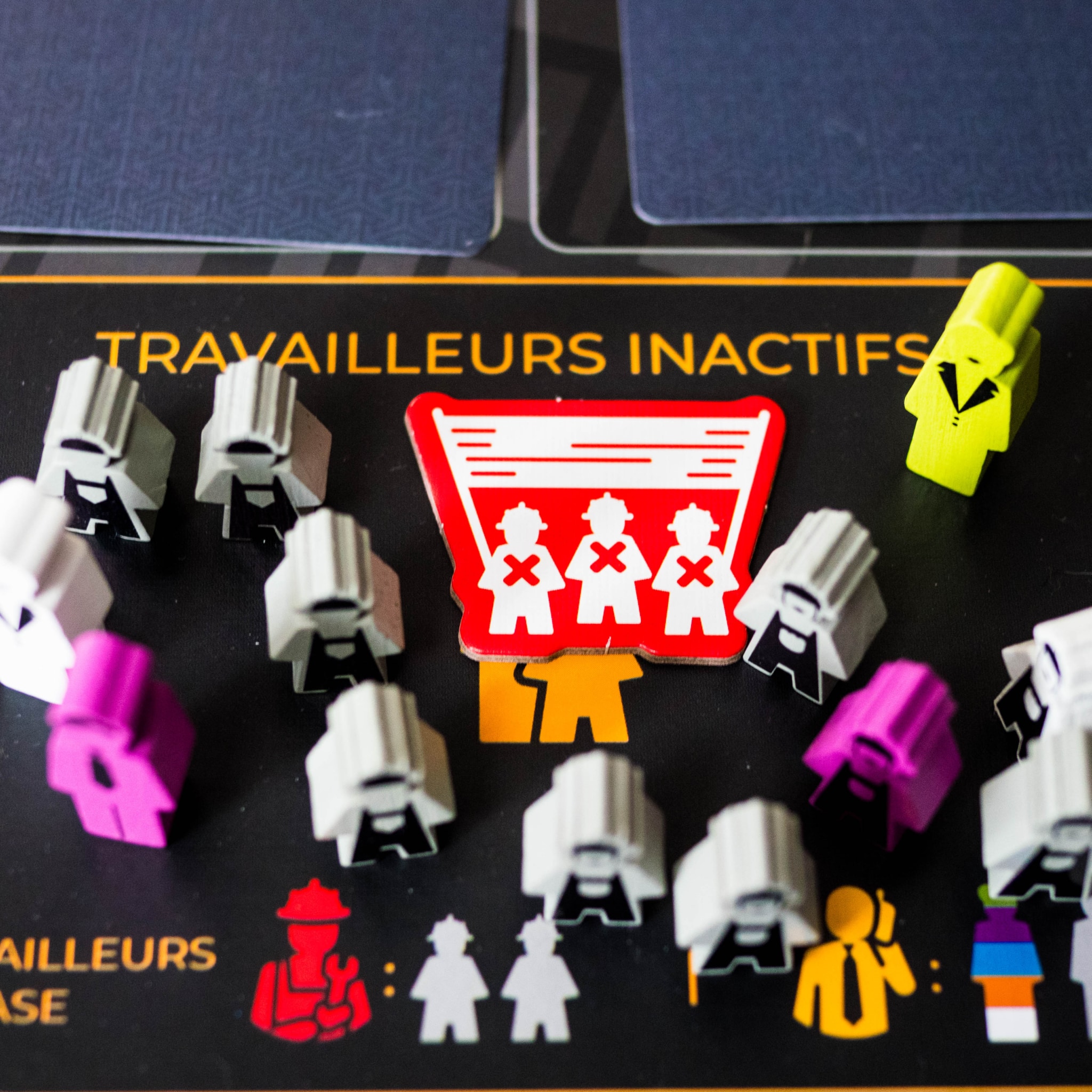
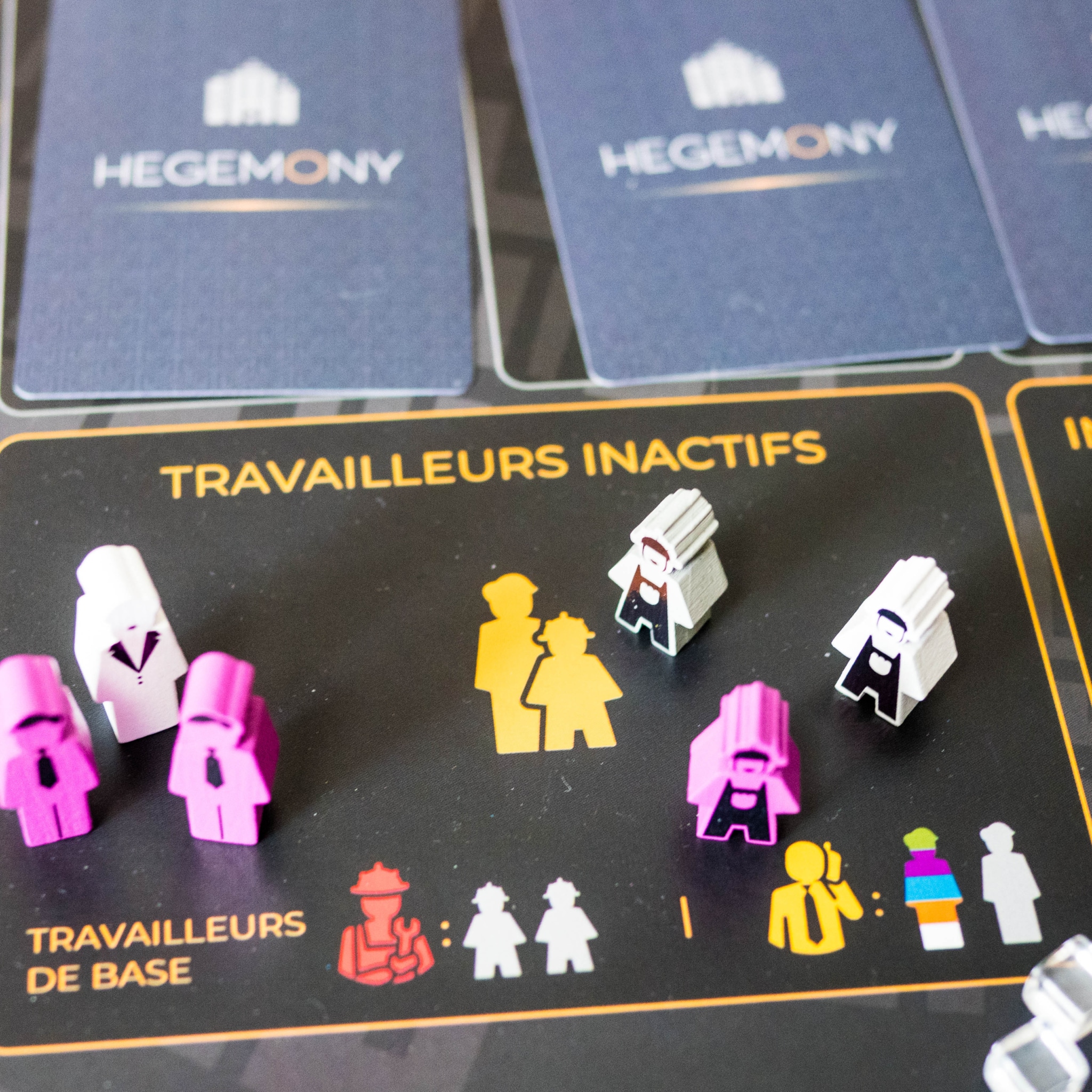
Assigning Workers: The Working Class and the Middle Class place their Workers in private or public companies .
-
Adjusting Wages and Prices: Readjusting the selling cost of products or employee compensation .
-
Commercial transactions: Buying or selling food, health, education, or influence .
The Working Class: providing a living for its population
The working class must first and foremost ensure the prosperity of its population. To this end, it sends its workers to businesses so they can earn wages, and then uses their income to meet their needs.
The Capitalist Class: Keeping Businesses Running
The Capitalist Class focuses more on accumulation and profitability. Its objective is to develop its businesses, produce resources, and sell these to other players in order to increase its capital.
The Middle Class: producing, selling and consuming
The middle class is probably the role that best illustrates the idea of economic equilibrium. It must develop its own businesses while meeting the needs of its population.
The State: maintaining the balance
The State is probably the most unique role in Hegemony. Available only in a four-player game, it must address the needs of the different classes while trying to increase its legitimacy.
3. Voting Phase
All Bills submitted during the round are put to a vote . Players draw cubes from the voting bag according to their representation and can use their Influence token or reserve to sway the vote.
4. Production & Consumption Phase
Businesses produce goods and services . Employees receive their wages and must meet their basic needs .
5. Tax Phase & End of Round
Taxes are levied according to the applicable tax policy . Each class keeps track of its victory points (VP).
Is it good?
Hegemony’s greatest strength lies primarily in its theme. It’s not simply a management game; you truly embody a societal model. Through its mechanics, the game becomes a genuine economic and political simulation. The relationships between workers, businesses, consumption, taxation, and politics are directly integrated into the gameplay. It’s quite rare to see a board game go so far in integrating political economy concepts like liberalism versus socialism, protectionism versus free trade, or public regulation versus privatization. Here, these concepts aren’t just mentioned for context; they have real consequences on how you play.
The game’s other major strength is, of course, its asymmetry. Each player truly has their own unique perspective within the game. If you embody the Working Class, you won’t think in the same way as the Capitalist Class or the Middle Class, and vice versa. As for the State, it has yet another completely different approach from the other classes. This is a real success, because each role forces us to understand and defend its own specific interests.
And most importantly, you quickly realize that everything is connected. Workers need businesses to earn money, businesses need workers to produce, the different classes then need to buy resources to ensure their prosperity, and the state collects a portion of that money through taxes. A decision that might seem insignificant to you can therefore have major consequences for the other players. It is this interdependence that makes the games particularly interesting and gives Hegemony the feeling of a truly living economic system around the table.
The voting system takes this even further. You’ll regularly have to vote on changes that directly alter the game’s economic and political dynamics. Some decisions will be extremely advantageous to one player, while others might be disastrous for another. Inevitably, this leads to lively discussions, negotiations, sometimes improbable arrangements, and even a few plot twists. This is probably one of the aspects that impressed me the most: if players truly immerse themselves in their roles, the voting system can create moments and discussions that are virtually unheard of in any other board game.
But all this richness inevitably comes at a price. Hegemony has a particularly demanding learning curve and is clearly not a game I would recommend to everyone. Games, often lasting over four hours, require a significant investment, as does the sheer volume of rules and the specificities of each role. The first few games can therefore be quite difficult to grasp, as you need time to understand the intricacies of the economic system.
I also find that the game truly shines with four players, when all four roles are represented. It’s in this configuration that the interactions become most interesting and the economic and political system truly reveals its full potential. But this also requires significant involvement from everyone. If a player plays their role without really trying to negotiate, discuss, or defend their class’s interests, part of what makes Hegemony so appealing can be lost.
In short, Hegemony: Class Struggle is a highly skilled, asymmetrical game that goes far beyond a simple management experience . It simulates, with astonishing coherence, the economic relationships, political power dynamics, and sometimes conflicting interests of different social classes. If you enjoy games where your decisions have consequences for everyone at the table and where negotiation plays a significant role, Hegemony definitely deserves your attention.
Despite its demanding learning curve and particularly long games, it’s the kind of game you rarely find on the market. Once everyone is truly invested in their role, the discussions, negotiations, and plot twists can lead to truly memorable sessions. Hegemony demands a lot, but it also offers a great deal in return.
My review of 172 Hegemony: Lead Your Class to Victory
Positives
- A very well integrated economic and political theme
- A pronounced asymmetry between the different roles
- A coherent and interconnected economic system
- A voting system that creates negotiations and debates
- Strong interaction between players
- Games that can create memorable moments
Negatives
- A demanding learning curve
- Many rules and specifics to learn
- Often very long sections
- An experience that demands a high level of player involvement
- The game reveals its full potential with 4 players
- Not very accessible to casual players or beginners