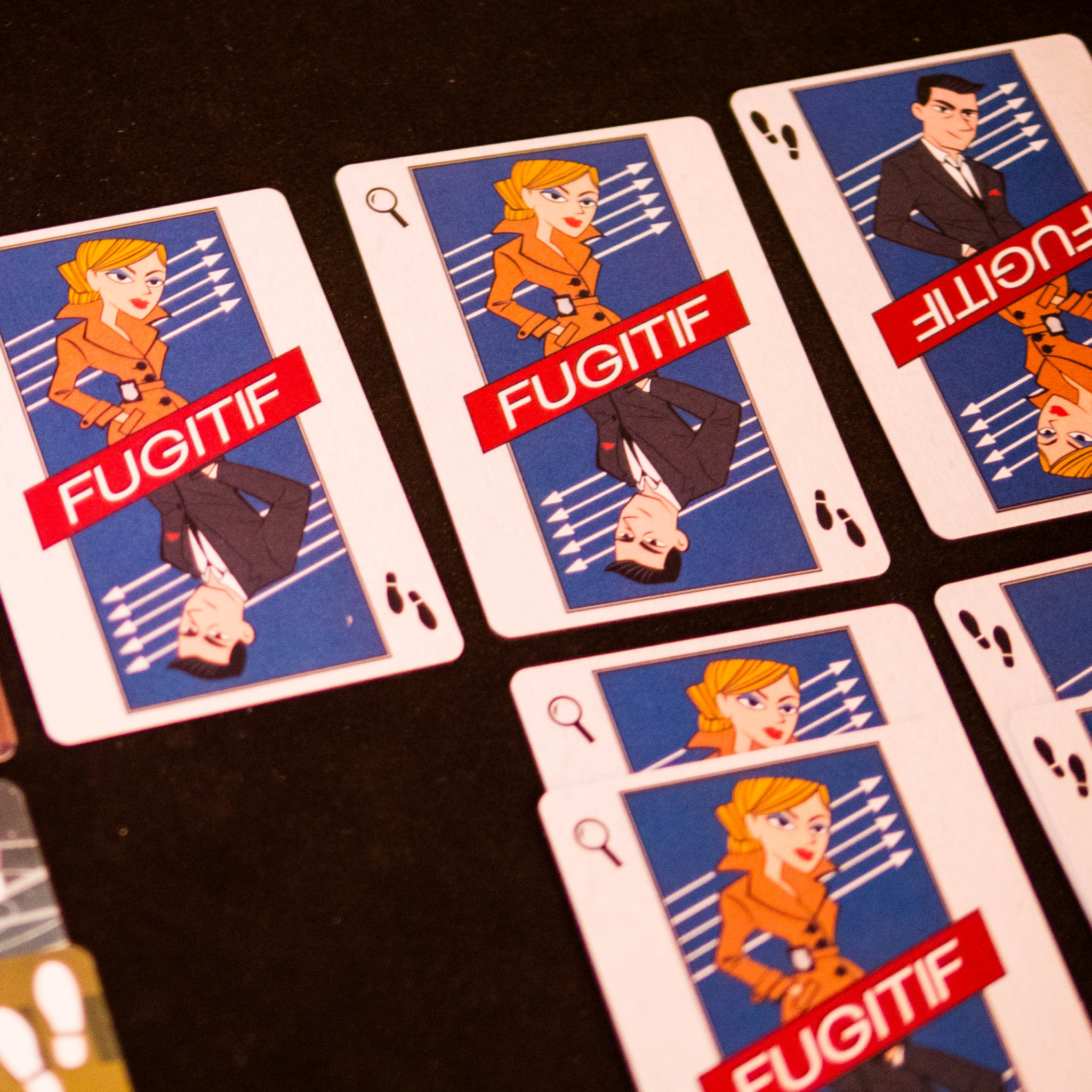
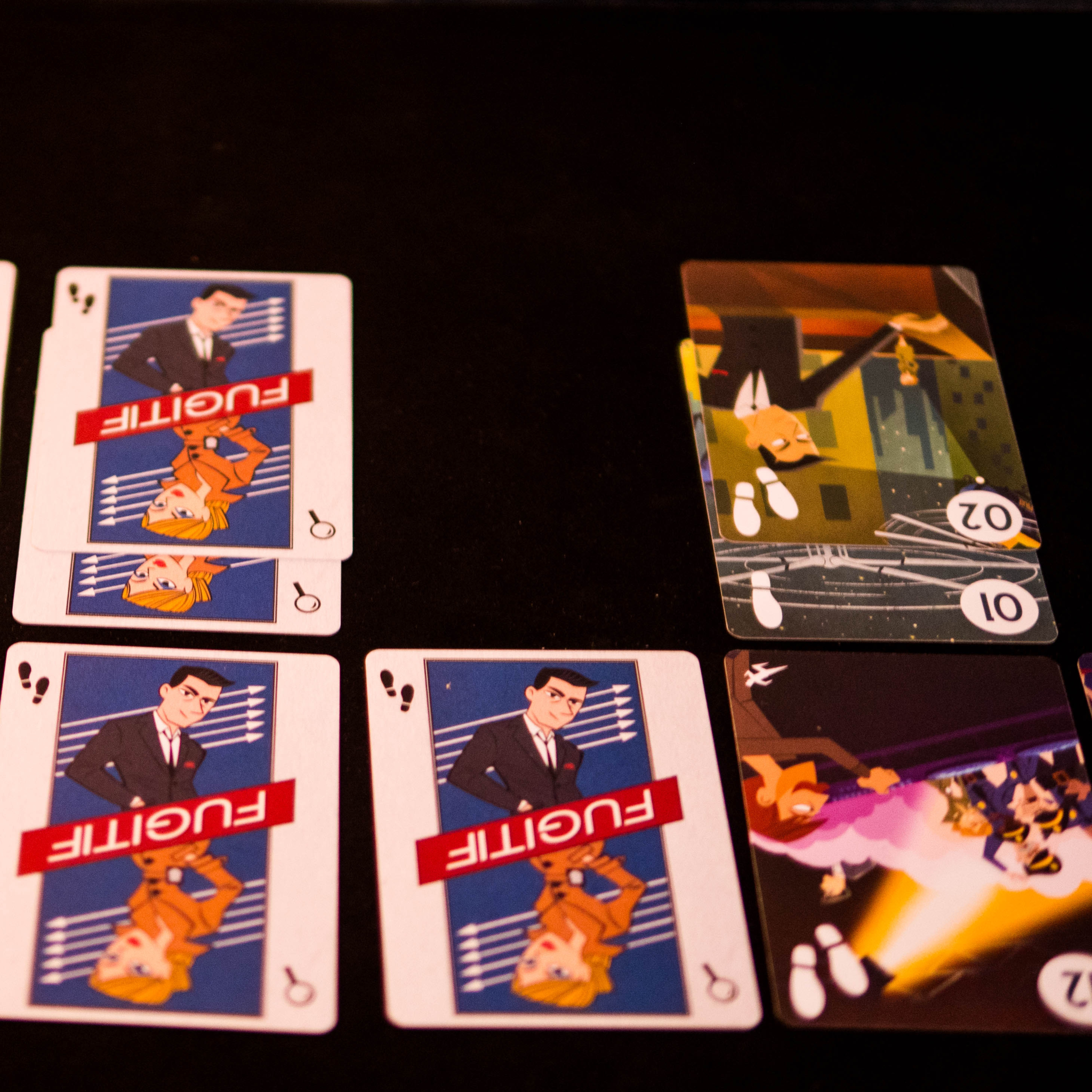
1. Implementation
The game begins with the distribution of roles: one player embodies the Fugitive and the other the Detective.
-
The Fugitive retrieves his first hideout cards, as well as the final card 42.
-
He then draws 3 cards from the pile numbered 4 to 14, then 2 cards from the pile numbered 15 to 28.
-
The remaining cards are divided into three separate draw piles: 4-14, 15-28 and 29-41.
-
The Detective receives no cards in hand at the start.
The Fugitive therefore knows the cards he holds and those he will be able to use, while the Detective must gradually reconstruct her opponent’s path.
2. The Fugitive’s Turn: Setting Up Hideouts
The Fugitive always starts the game. On their turn, they draw a card from one of the available piles, then decide how to progress towards their final destination.
He can place one or more hiding place cards face down, respecting certain constraints:
-
In the first round: he can set up one or two hiding places.
-
On subsequent turns: he can place an additional hiding place or choose to rest.
-
The progression: the cards must be placed in ascending order.
-
The limit of progression: two consecutive hiding places cannot normally have a difference of more than 3.
For example, after placing a number 10 hideout, the Fugitive can normally place a number 11, 12 or 13 card.
But there is a way to speed up his progress: using additional cards representing steps. To make a larger jump, he will need to add as many cards as necessary to compensate for the extra distance.
This mechanic forces the Fugitive to find the right balance between speed and stealth. Moving too quickly can cost them valuable cards, but taking too long gives the Detective more opportunities to discover their hiding places.
3. The Detective’s Turn: Conducting the Investigation
After the Fugitive’s turn, it’s the Detective’s turn.
She begins by drawing cards that are not in her opponent’s hand. She draws two cards on her first turn, then only one on subsequent turns.
These cards allow him to gradually eliminate certain numbers and refine his deductions.
She can then announce one or more safe house numbers to try to discover those of the Fugitive.
She has two options:
-
Announce only one number: if the corresponding hideout exists, the Fugitive must reveal it. Otherwise, no card is revealed.
-
Announcing multiple numbers: The Fugitive only reveals the cards if all the announced hideouts are actually present.
The second option allows for more ambitious attempts, but it requires greater certainty. A miscalculation could thus cause you to miss a valuable opportunity to discover a hiding place.
4. The endgame: succeed in the escape or arrest the fugitive
The game ends when one of the two victory conditions is met.
The Detective wins the game if she manages to discover all of the Fugitive’s hiding places before his escape.
The Fugitive wins the game when he manages to play his final card 42 and reach his destination.
There is, however, one last subtlety: if a hideout numbered 29 or higher has already been revealed, the Fugitive escapes immediately.
Otherwise, a final manhunt begins. The Detective must then guess each of the remaining hiding places. If she finds them all without making a mistake, she arrests the fugitive. At the slightest error, he manages to escape and wins the game.